Wednesday, 25 January 2012

Jobs in the industry

As part of our contextual studies we were asked to research various roles within the games industry, focusing on two in particular. For a general overview of a large cross section of these roles I found the following webpage http://www.blitzgamesstudios.com/blitz_academy/job_roles/art to be particularly  helpful, and as such have sourced some of their information below.

3D Modeller and Texture Artist

3D Modeller & Texture Artist

3D Modeller & Texture Artist
As the name suggests, the 3D artist's working day consists of creating objects, characters and scenery in three dimensions. Most of this work will usually be achieved in one of the major 3D software packages, such as Maya, 3D Studio Max, Softimage XSI or Lightwave among others.

The artist usually works from a piece of concept art and creates the model (otherwise known as an art asset) from start to finish. This includes building the initial model, the creation and subsequent application of texture maps, the addition of project-specific blind data, and in some cases visual effects nodes, and even hardware graphics shaders. Though this all sounds rather daunting, the ability to model and texture well will get you through the door - after that the rest will come as you learn on the job.

Some companies make a job role separation between 3D Artist and 2D Texture Artist; however, most expect the 3D artists to complete the texturing phase as well as the modelling.


Technical Artist

Technical Artist

Bridging the gap between art and programming, the Technical Artist has emerged as a new team requirement in many progressive game companies.

The role can emerge from either the art or programming disciplines and works across both the aesthetics of the game and the underlying technology of the game engine and target platforms. The exact job description of a Technical Artist does vary from company to company but includes one or more of these roles: - plug-in creation / script creation / technical documentation / hardware shader creation / visual effects implementation / general art asset creation and trouble shooting.

Having the ability to write scripts and plug-ins in addition to normal artists' duties means that the Technical Artist is able to maintain and improve the production pipeline as well as the overall visual quality of the game. Most top-level Technical Artists also have an acute understanding of the target hardware and, in some cases, are able to write hardware shaders and do general programming in C or C++. This is an up-and-coming role that is currently highly desirable within the industry, due to the huge positive impact that a good Technical Artist can have on a project.


Visual Effects Artists

Visual Effects Artist

Another specialist area is special effects. This artist defines, creates and refines all special visual effects for the game. Strong skills in texture creation, coupled with an acute understanding of particle systems and geometry effects are key. Visual Effects Artists often have a good understanding of the technical restrictions of the target platform and will always work very closely with a programmer to create the effects.

Having a good level of target hardware knowledge really helps this role, as finding creative ways to produce striking and efficient visual effects separates the best from the rest. Additionally, the ability to technically deconstruct visual effects from other products helps to keep the team and company at the cutting edge as far as visual acuity is concerned.


Concept Artist

Concept Artist

When a new concept for a game asset or feature is required, it's the job of the Concept Artist to realise that concept in a visual form. Concept Artists usually draw a 2D image of the required asset, environment or character, which is then passed onto production and/or included in documentation.

The Concept Artist is responsible for envisioning and presenting the visual style of the game under the direction of the art or creative director. Superlative skills in draughtsmanship coupled with a vivid imagination and a range of styles are the keys to success. The best Concept Artists live to draw! Being able to draw and render well in traditional as well as digital media is a prerequisite, as well as having the ability to constantly refine your work and accept constructive criticism.

The Concept Artist has the freedom to define the look of a whole game, so accepts a great deal of the responsibility for the final look of the game. The Concept Artist role is a demanding, pressurised role that is offset by a great deal of creative freedom and reward.


GUI Artist

GUI Artist

Usually found in larger developers and publishers, GUI (graphic user interface - pronounced gooey) Artists usually stem from a graphic design background. Primarily responsible for menu systems and in-game 'score' elements, the GUI Artist must have good layout, graphics design and typographical skills. Many GUI Artists also have major input into the design and flow of the game's front end (menu system) and HUD (head up display).

Because the GUI is the first interactive visual element that a gamer will see in any game, it has to be engaging, clear and artistically excellent. GUI Artists have a lot of responsibility in this respect and therefore they are usually motivated and driven by the desire to produce great graphics.

With the earned ability to influence the flow of the front end, there is considerable responsibility as a poor front end can break a game.


Texture Artist

Texture Artist

Some companies separate the modelling and texturing job roles, which naturally means that some artists become experts in 2D texture creation and application.

Games rely very heavily on high quality texture mapping. The creation of these texture maps and their application has grown ever more complex as game art has steadily increased in quality. There are now so many different processes and applications available for creating and applying them that game artists can easily specialise in this area. The close relationship between model topology and texturing means that Texture Artists normally work very closely with 3D Modellers.

The increase in the use of hardware shaders on the new game platforms has also increased the demand for dedicated Texture Artists, especially those that have the technical ability to create and modify hardware shaders

     Out of these various potential careers, Concept artist and 3D modeller stand out to me in particular. Although I happen to know from general research and conversation within my course that conceptual artist is an exceptionally popular choice for a lot of people. Though we have only just begun using Maya in lessons I am enjoying what we are doing already, hence my interest in 3D modelling, however there are several processe named within its description that I do not fully understand therefore this will require further research. Also while programming itself deviates quite a lot from my interest in art, this is an area I am particularly inexperienced in and would certainly be interested in learning to become more adept at, whether or not I find myself using it much later on.

Using Maya

     In the last week and a half we have begun using Maya to create basic animations. Our first lesson gave us a feel for the program where we learnt simple controls, how to create shapes, and how to navigate around it. The next two sessions were spent creating a very basic animation of a ball bouncing. We were required to apply the squash/ stretch factor that we learnt about in our animation research. We also spent a session with our tutor Mark beforehand, going over the process so as to tackle it most efficiently when we approached it ourselves. It also introduced us to new techiques such as the graph editor and tangent breaking. Most recently we have spent a session practising animation a ready made and rigged character which we have taken away to work on further. We will be required to create a walk, run and jump cycle for this character.

Tuesday, 10 January 2012

Principles of Animation- In Game Examples

As part of our research on animation techniques we were asked to take the principles we learnt about in our previous session, and find in game examples of each of them, both positive and negative.

Squash and Stretch

Anticipation
Good
Manhunt
"Manhunt" was all about making violence as graphic and visual an experience as possible, which fuelled the controversy that it created as a game. Resultantly many of the murders in the game have a gritty, high tension build up, clearly defining to the audience the nature of the scene, and allowing them to predict what exactly will happen.
Staging

Straight Ahead/ Pose to Pose
I don't know what to do for this.
Follow Though/ Overlapping
Good
GTA IV
This scene shows the secondary action of the charater rolling along the ground, out of the player's control, after the controlled action of diving out of a vehicle. The physics engine within the game ensures that this movement is dependent on the speed and direction your character is travelling at, making each time unique and interesting for the player to watch.
Bad
Tomb Raider
In this video of one of the older versions of "Tomb Raider" you can see clearly, particularly when Lara is jumping backwards and rolling around, as she likes to do, that no momentum is carried through once she is back on her feet. This results in the character's movements looking jarred and unnatural.
TimingSlow In/ Slow Out
Good
Need for Speed- The Run  
The most obvious "good example" of this principle to me, was one that quite literally requires the use of acceleration and decceleration. Cars do both of these. And this game is about cars.
Arcs
Good/Bad
Fight Night Round 4
This clip gives valid examples of both good and bad arcing. The "Fight Night" series prides itself on trying to make character movement as realistic as possible and I think this shows in general, particularly with the haymaker punches. However at the points where they get it wrong, it is both obvious and distracting to the gameplay- and very much noticable when it occurs within this video, making the movement look very unnatural.
Secondary Action
 Good
Skyrim
This clip from "Skyrim" shows the secondary movement of the characters arms and weaponry, which are further exaggerated when the character is sprinting. You can clearly see how this improves the visuals of the game and makes for more realistic character movement, particularly when compared with it's predecessor "Oblivion"
Timing
Good
Max Payne
Max Payne is amazing fun, one of the best parts being the ability to slo-mo dive through the air- WHENEVER THE HELL I WANT- and destroy people with bullets. Clearly timing is an essential aspect of this, and let it not be forgotten!

Exaggeration

Good
Hercules
Here we have a clear example of how extreme exaggeration has been used for a child friendly and comical visual style. From the over zealous swing of Hercule's cape, to the hyper-extension of his knees the entire game screams of exaggerated movement. 
Solid Drawing

Appeal
Bad
Lord of the Rings- Conquest
This is a clear example of a game that made me put time and effort into completing its main storyline, with the promises of rewarding me with a never before seen alternate storyline where Sauron prevails. This was diminished somwhat by the fact that playing as the Nazgul, which should be awesome, was dull and distinctly not fun.

Monday, 9 January 2012

Principles of Animation

     We have now returned to NUCA for our new term. Within this unit (BA2) we will begin by learning the basics of digital sculpting/modelling, and how to go about combining this with animation. In our first lecture we learnt about Disney animators Ollie Johnston and Frank Thomas,  and their development of the "12 Basic Principles of Animation". These principles are as follows:

     -Squash and stretch: This gives a sense of weight, flexibility and depth to the object/character. It is essential that the volume of the object does not vary within the animation, therefore changes within height/depth etc. must interact accordingly.
     -Anticipation: Antipations prepares the audience for a particlar action, and in turn makes that action more realistic eg. a character bending his legs before a jump. Ommiting anticipation before an action is also sometimes used for comedic effect.
     -Staging: Staging directs the audience's attention, and clarifys what is happening and what is about to happen within the scene.
     -Straight ahead action/ Pose to pose: Straight ahead action requires drawing a scene frame by frame till the end of a sequence which, whilst considered more effective for action scenes, can result in failure to maintain proportions. Pose to pose means drawing the first and last frame and filling in the intervals. It is common for a mixture of both techniques to be utilised.
     -Follow through/ Overlapping action: This goes towards making animations of characters and objects that much more realistic. For example after landing on the ground, coming to a sudden stop, parts of a character's body will continue to move, just like with real life physics. Overlapping is when different parts of a character's body will move at a different pace, again like with a real life person. Emphasising these effects is sometimes used for comedic purposes.
     -Slow in and slow out: This reflects the real life nessecity for any moving object to accelerate into movement, or deccelerate to a stop, as opposed to reaching speed immediately.
     -Arcs: Arcs are generally used within the animation or organic characters or material. One might deviate from this if the object being animated was mechanical.
     -Secondary action: Secondary action accompanies the main action to make it more lifelike. A character running down a hallway would also pump his arms as he moved. Something to be noted is that the secondary should not distract from the main action but simply accompany it.
     -Timing: "Timing refers to the number of drawings or frames for a given action, which translates to the speed of the action on film.[14] On a purely physical level, correct timing makes objects appear to abide to the laws of physics; for instance, an object's weight decides how it reacts to an impetus, like a push.[29] Timing is critical for establishing a character's mood, emotion, and reaction.[14] It can also be a device to communicate aspects of a character's personality".
     -Exaggeration: Levels of exaggeration within animation would be determined by the visual style of whatever is being created, but as a general rule it seems to be considered nessacary to at least a small degree, purely to prevent the animation looking lifeless.
     -Solid drawing: This means understanding and comprehending the 3D nature of your character/obeject, and utilising this when taking into account aspects such as volume and weight.
     -Appeal: This means creating a charismatic or identifiable character that will appeal to an audience. Kind of a given really.


Sunday, 20 November 2011

Here have an essay. Its the cherry on the cake.

To what extent do modern games use personal identification and escapism as a tool for engaging audiences?

     There has been a vast change in the structure of modern games as opposed to their predecessors. As the market and production of these games has inflated over the years, potential customers haven’t exactly been limited for choice as they once were. Therefore developers have `had to adapt in their approach to attracting customers, and being the first to offer something different. A key element of this adaption has been to focus on audience engagement, in particular by focusing on the potential of escapism and personal identification within these games.

     Why do we play games? What is it about them that appeals to us. In my mind it is that they allow us the opportunity to briefly become that which we have long sought after yet never accomplished. Ungrateful though it may sound, life thus far has been a disappointment. Whilst it is true that I am lucky enough to have been born into a country where it is ensured that I will be well watered, well fed, sheltered and kept in good health, none of these things excite me. I have no otherworldly powers, no godlike strength, and no extreme abilities in hand to hand combat- as a result, life has become tiresome and dull. Playing games is one of a few areas where this ceases to be true. In the blink of an eye I can choose to be a high rolling 1930’s New York gangster, or a demi-god warrior, or a cute, fluffy Labrador with big eyes and...Maybe scratch the last one. My point is that we are finally given the chance to become our heroes. “We play games because we want to feel like rock stars, warriors and gods. We play to shape the world that has been given to us. The developers give use the space to move, and the rules to follow; the rest is up to us.”(http://videogamewriters.com/the-death-of-escapism-the-demise-of-america-in-video-games-1549. ) This temporary suspension of reality as we live out our fantasies is escapism in it clearest form. By identifying the disappointment of our own lives and offering us the chance to reverse it, developers easily manipulate an audience into buying their work. Thus they have effectively used the opportunity of escapism as a viable tool for audience engagement.

     Furthermore some have decided to go a stage further. Nowadays it is a common concept, particularly in genre types such as MMOs, or games like “Fallout” and “Fight Night”, to be given the option of a fully customizable character. Now not only can we act out the moments we always dreamed of, but we can do it all with a character that is an exact replica of ourselves. This level of self delusion draws us into the realms of personal identification. No longer is this character merely controlled by us, he/she is now a walking, talking, clone. As a result the game is no longer just a fun relaxing timekill. It is an extension of our own lives. For example; my character now works on the side as a fisherman in order to support his second family as they struggle through the global recession so no, I will not be going to work tomorrow, and yes it is important. Whilst reading this now seems ludicrous and comical it is, in fact, shockingly in touch with the lives of modern players. I know people who have dedicated entire weekends to “building up their character”. I know more still who have taken a day off work so as to stand in a queue to pick up a game that could just have easily been bought that evening. Now not only have the game developers led us away from the focus of our own lives, they have encouraged us to establish a new one, structured as we see fit, and much easier to fix/eradicate should things turn sour. So in this instance developers have used escapism in the form of personal identification as an audience engaging tool.

     What is arguably a helpful factor of gaming for those in the industry, whilst potentially damaging to players, is the idea of game addiction. Rather than focusing on the most extreme, exaggerated, and most definitely rare cases, eg. Boy dies of exhaustion after 11 day Xbox marathon, I am, instead, more interested in the more common, yet often ignored, element of achievements/unlockables/scoring in games. “Some argue however, that escapism may ultimately become addictive. For example, current studies are now focusing on the emerging condition of Internet addiction. In Internet addiction, people may spend most hours of the day and night surfing the Internet. They may do so in preference to working in the world, or in preference to having “real life” relationships with other people. What begins as a mere search on a topic, may end in a life lived in front of a computer monitor when escapism becomes extreme.”(http://www.wisegeek.com/what-is-escapism.htm. ) Achievement lists and gamescores as they feature on console networks have become virtual trophies in the world of gaming. These things shouldn’t matter- yet somehow they do. Many a game I have played has survived an extra 3+hours purely by having me jump through hoops in order to gain something that, with an outsider’s perspective, I wouldn’t really care about. I would consider a key example of this to be “Spiderman 3” on the PSP. After letting me use the black suit through the majority of the narrative, the game then has the audacity to reward me for my commitment and patience by stripping me of my only incentive for buying it in the first place. Then it tells me I can earn it back by collecting the web pieces scattered across the city. This was a laborious, painstaking and most certainly NOT fun exercise which I heartily undertook purely because I knew just how much it would mean to me to spend the next year of my life swinging round New York in my flashy new threads. Not so. Shortly after gaining the suit I realised that New York was simply not the happening kind of place it once was and that there was little fun left to be had. Did I learn from my mistake? No. Did others learn from theirs? No? Time after time we cast away precious man hours trying to earn a fancy cape, or a diamond machine gun or the bronze plated tea set- only to forget about it when we realise it actually humoured us very little. This is the kind of addiction that has a true impact on gamers. Only this level of involvement could encourage a man to invest his own, real-life, hard-earned cash, into buying his virtual horse a new saddle because it comes in this seasons shade of blue. Once again an extreme level of escapism, addiction via distraction has become a tool for game developers to engage and manipulate their target audience.

     In conclusion the use of personal identification and escapism in games seems to be used to a vast extent, often in ingenious ways- and on various different levels. Not only to engage players, but also to entice them and draw them away from the focus of their own lives.

Finish Line

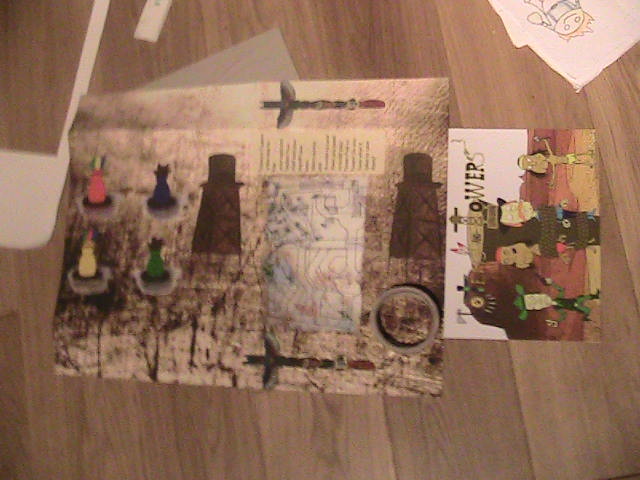
 Sent box design to printer. One and a half days later the above was printed off. Result. I then cut out the net using a scalpal and a metal ruler. After this I used the scalpal gently to score the fold lines and applied double sided tape to the box flaps- then proceeded to assemble the box.
 These next pictures display the finished result. I made some minor adjustments to the flap sizes so the box slid together more easily. I also applied sticky backed magnets to the cover flaps so it can be held down.
 Essentially our project is now finished. All that is left to do is submit our work. It has been a rewarding yet tiring experience. Overall, whilst there are certain areas I would like to improve I am happy with the outcome- and confident that our group has been able to produce a successful game.

Tuesday, 15 November 2011

     Just to give an idea of what to expect from the box design before I create/ print it, I have very quickly marked out the major details and where they will appear. Planning it out in this way will also help me to shave small but valuable amounts of time from when I get round to creating the design. The main issue at this point is that the design requires pictures of the finished versions of certain parts of the game- eg. character pieces, gameboard. However these are not completely finished as yet, therefore I am currently caught between trying to include these, and getting the printing done as soon as possible. We'll bring you more news on this matter as the situation develops. Back to the studio.