Showing posts with label WW2 Research. Show all posts

Wednesday, 13 February 2013

Tank Texture

     I have found another great website which has helped me with my model. Here someone has made a tank the same model as mine which has been really helpful to look at.
More information on the model can be found here http://www.antos.ca/freebies.htm


I have now stuck in to the texturing process of my work. This has led to several different developments.

Problems
The first issue I ran in to luckily occurred whilst I was at Uni. Therefore Lothar was able to show me how to fix it. I am not sure how it happened but I had manage to parent a lot of the objects in my scene unintentionally. This led to problems when I tried to duplicate some of my textured objects but was relatively easy to fix.

The second issue came later. I had organised the different textured group objects into corresponding layers, When I was rearranging these however it became impossible to remove certain objects from a layer. I was able to fix this eventually just by deleting and recreating the layer.

Texturing
Throughout this project a lot of people have looked to the internet for textures to use on their model. I have spent a lot of time working on my tank in Maya and am really proud of how my abilities have developed because of this. In keeping with this it was really important to me that my textures should be completely made from scratch. This has taken up a lot of my time and has forced me to work further into the last week of my deadline then I had hoped for however it is still something I am glad I made the choice to do- and furthermore it has been another big learning curve for me within this project.
I found a really helpful tutorial online that was actually made for a tank model which can be found here: http://www.moddb.com/tutorials/all-texturing-tutorial. This gave a fantastic step by step guide to creating colour layers, metallic textures, variations in shades, chips and damage, plus dirt, grime, and mud layers. Applied to the model this creates a really pleasing effect.
     Decals
Another step mentioned in the tutorial includes decals. It is important that the model isn't completely bare of any insignia as this will look unnatural. It is also important that these details must have suffered similar wear to  the rest of the tank.

I looked at images like this to make sure I obtained the right kind of decals. In the end I opted for a minimal touch, just including the tank number and a small logo.

Though the tank will be the same colour pretty much all over, I have adjusted the shades slightly on the different texture layers so there is some variation.
It was important to take into account what part of the tank I am texturing and how its surface may vary. This image shows the wheels layer which I decided , as it was closer the the ground and the various terrain rubble, would be heavier affected by chips, scratch, mud and grime. Again it seems like a small difference but it really helps once the whole tank has been textured.

Tank Research

I have been looking at extensively at images of tauchpanzers to help me with texturing it, and also to influence some touch ups to the model.

I have found in particular that model kits of these tanks have been particularly useful for establishing some of the key features of the tank. Whilst useful to a point a lot of the photographs of this type of tank tend to be very old and poor quality, and therefore very difficult to establish detail from. Another good thing is that model making is usually such a serious and painstaking hobby that the models tend to be very accurate and are therefore fantastic resources.

There are a lot of different versions and additional features for this tank so it is important to look at as many different versions as possible to get the right idea for my model.

This image shows some of the waterproofing that can appear on the tanks. It would have been really nice for this project to include some fabrics and materials, however at this point I would not have the time to do this. However it is something I would like to try in a future project.

I found this uncompleted model was particularly useful when it came to building the wheel struts, as this was generally hidden from view in most of the images I have found. I feel that paying attention to some of these extra details, even if they are not immediately visible, contributes to making my model a little more realistic and impressive.

I need to come away from this project with the model version of this.

Wednesday, 14 November 2012

George- A Portrait

     As mentioned in my last post, the previous picture I did of main character "George" has been reassigned for the mood art section. Therefore I decided that another piece, this time a more portrait style, would be in order. I was inspired by the cover image from the fallout game design document that we have been using as a guide (pictured below).


 Here one of the characters has sent a photo of him self in army (or the fallout equivalent) uniform home to his mother. I thought it would be good to have a similar theme with george having sent home a photo to his wife Nancy saying how much he misses her. What makes this even better I believe is that the game focuses so much on the relationship between these characters, making it quite relevant as imagery for character representation.


new george picnew pic guys

The two images above show my WIP and final stage. I am pretty happy that the tone of this piece is intouch with what I intended when I first started. My main disappointment would be the fact that my handwriting is so appalingly crap, the message dosnt look quite so romanticized. Overall however I am pleases with the result. My next work now is to look at marketing and future potential of the game, and also to crack on with my contextual studies work.


Friday, 2 November 2012

George- A major Character, Georges level design


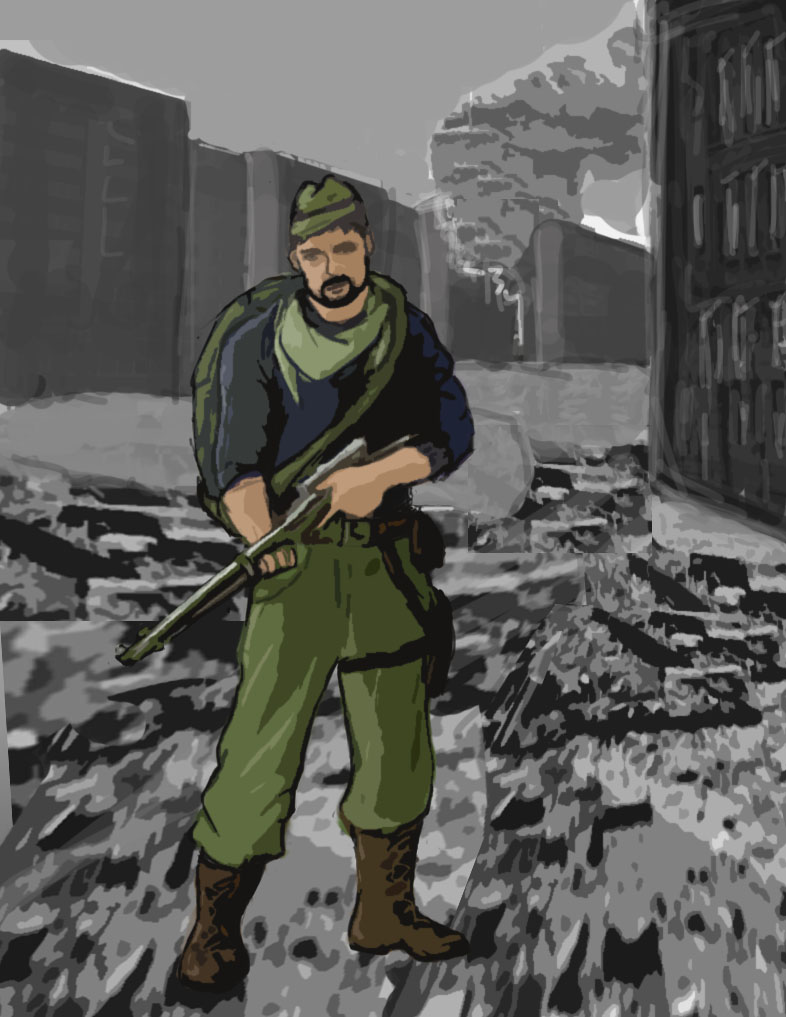
 I have now finished the concept art for my character "George". As you see in the first two images I tried a slightly different style for the character and had my group choose between them. We opted for the simplified almost comic style but with more detail on the gun and face. I wanted this to be a quicker concept piece, used to get the mood of the game across, hence the background in particular is much less refined then the tank concept I did before.
     I gave the image an old photograph style effect to reflect the nature of the game and added some shadow to establish his position on the ground.
     Part of my responsibility was to write Georges character bio and level design for our Game Design Document. This may need tweaking or adjusting to fit with the other characters before we submit therefore I opted to do this after finishing my concept, so as to give me and my group plenty of opportunity to review it if necessary. They read as such:
George signed up for the army at the beginning of the war, determined to do his part. His outstanding performance in training led to him being enrolled in the Royal Marines. This was however shortlived. George was one of several established military men encouraged to return to the UK, in order to provide balance in leadership and capability amongst the many inexperienced men, being recruited for the British Resistance Organisation in the threat of a mass invasion. With his wife Nancy’s increased involvement in the war he felt duty bound to return home. His efficient training with the Royal Marines was more than beneficial when it came to making do with the comparatively poor supply of weaponry provided by the resistance however despite his physical aptitude as a soldier, George is struggling with the level of leadership he is having to take on, and the frequent losses of those he regards as comrades- combined with the decisions he is forced to make, and the constant worry of Nancy’s dangerous level of engagement with the resistance is starting to have a profound effect upon him.

Appearance- Mirroring his mental state Georges appearance becomes increasing weathered and dishevelled as the invasion progresses. Whilst favouring an army side cap, George’s position as a survivor of a shattered unit of the BRO leaves him opting for whatever attire best suits his current objective- generally dull civilian gear that is unlikely to draw too much attention. Whilst his unit was not the best stocked, his survivalist, waste not want not attitude provides him with, at least, a reasonably respectable arsenal of weapons and gear.

Personality- Whilst previously mild mannered and somewhat meek in character, the impact of the war and the role he has been given is proving to be his undoing, and has begun to manifest itself in his increasingly sadistic attitude to dealing with the enemy, as well as his secretly despairing mental state. That said, his ability to achieve in that which he focuses on balances this somewhat and in itself is making him a key figure in Britain’s retaliation.
  
George Mission 1
George has been relocated to Britain as a member of the BRO. Part of his duties involves reconnaissance work of buildings such as country houses in the area. On one such assignment his eye is drawn to the arrival of a French officer, a fellow resistance member entering the building. Upon further investigation he discovers that BRO HQ locations are being leaked, and that his own unit is threatened by imminent attack. He makes it to the base and as he is warning his crew explosions occur round the entrances of the base, caught off-guard many of the BRO are killed by an attack team. George opts to set off minor detonations to torch the rest of the base in order to let the remaining men escape, whilst preventing them from rescuing any wounded. As an officer he is aware of a secret exit and they make their escape, emerging with only a fraction of their original unit.

George Mission 2
Planned attacks upon Resistance HQs have been interpreted as  a warning that a German invasion may be about to occur. Remaining BRO members as well as Home Guard members and as many willing civilians as possible are assembled upon the coastline of Kent in preparation. German ship can be seen emerging, but also strange shapes floating on the surface closer to the beach. These are revealed to be breathing apparatus for a mass army of amphibious German Tauchpanzers which storm the beach. The poor organisation and communication between the BRO and Home Guard results in them having to retreat from this unexpected opponent.  Several of the more experienced members including George and his remaining officers us as many explosives as they can to take out the tanks, but with so little help they quickly become the main target and must fall back also. As they retreat small attack teams like those that assaulted the BRO in mission 1 emerge and engage in gunfire with BRO and civilians alike. Sickened by the sight of locals being gunned down George’s team strike back, with George becoming increasingly violent towards the German soldiers. More and more civilians join their small party seeing it as their best chance of survival. They fight their way to a army truck and leave Kent, Rescuing civilians on the way, but also having to consciously leave many to the mercy of the invading forces.

George Mission 3
With Kent and Sussex now occupied a major concern is losing London.  As many men, and even some female civilians, as possible are assembled and split into two units. With an “attack is the best form of defence” attitude, the two groups go to take back ground. This time the unit is much better organised, they attack ground and air units simultaneously and launch ambushes at the same time. The mission looks set to be a success until a radio broadcast warns that the Sussex attack was unsuccessful, and troops are now emerging from that direction. This turns the tide of the battle and the resistance take heavy losses, success seems unlikely and they prepare for what they believe to be their last battle; however they last out long enough for allies to emerge. With the increased threat of a Germany occupied Britain, the Republic of Ireland has relinquished its neutrality and assembled small but effective teams combined with air units which are now aiding the resistance effort. Together they take back a large section of occupied Kent, and prevent any advancement from the Sussex direction.

      I found the following web addresses to be useful to help me plan some of my characters bio and missions  http://en.wikipedia.org/wiki/British_Resistance_Organisation
     File:Auxiliary Units, Operational Base, emergency exit, Wivelsfield.pngThis picture of a secret exit from the BRO base is what inspired the final part of mission 1 for me.

     As we need a pretty sizable amount of artwork in our document I will now be cracking on with a new piece. In our most recent crit session one of our tutors advised us that we should be creating art to suit the game document, and not the other way round. With this in mind one of our group compiled a list of the various sections of our design document, and which of these would benefit with some additional artwork. Accordingly I have decided to do something for the gameplay section, a first person perspective stealth kill. More work to follow shortly.

Sunday, 28 October 2012

Concept Arts

     I decided that a good way to break up the work on my tack concept would be to have a character one happening simultaneously, therefore I decided to start drawing the husband character for our game. As he is supposed to be a member of the British Resistance Organisation, or at least something similar, I used some of the information in the website linked below along with this picture to decide upon how he would be attired.
http://www.dailymail.co.uk/home/moslive/article-2053692/Resistance-When-Nazis-took-Wales-new-film-Britains-secret-underground-army.html

George (Iwan Rheon), a young member of the British Resistance Organisation (BRO) in ResistanceSome of the weaponry made available to resistance fighters on display at the Museum of the British Resistance Organisation in Suffolk
I also thought the weapons picture may be useful If I am required to design equipment for my character. Using these references this is the progress on my character so far.


The good news is that I have also finished my tank concept now, the two images below show my stages of progress.


I am reasonably pleased with how this has turned out and will now start working on my next piece of art, a 3D head sculpture of my soldier character.

Researching like a pro

      Knowing that are game would likely be based around a German invasion of Britain we had to take into account that Germany never actually achieved this, why that might be, and how we could change this realistically in our games history to account for their success. The following are notes I have taken from various websites on what made an invasion unlikely, and at what points it could have been effective.
The allies narrowly avoided postponing D-Day by a fortnight to a date when the weathermen would have given the go-ahead and the result would have been utter defeat in storm-tossed seas. No detailed account of the forecasts has been given in the media before.
Previous accounts relied on the interpretation of James Stagg, a Meteorological Office man seconded to the RAF. But he merely reported to Eisenhower the analyses of three two-man teams of forecasters from the Met Office, the United States military and the Royal Navy.
Only the Navy men, Lawrence Hogben and Geoffrey Wolfe, survive. Dr Hogben said: "We six never agreed about anything except that Stagg was not a good meteorologist and that he was a bit of a glory hound." The six worked for months before D-Day, perfecting forecasting techniques many of which are still in use.
        Then Eisenhower would have a two-to-one majority in favour, the attack would have been June 5 as Eisenhower wanted. The weather was terrible that morning, with Force Six winds and high seas."
But a telephone call from the two naval officers stiffened the resolve of the civilian forecasters to resist the Americans.
The Met Office forecasters refused to change their opinion of June 5 and Stagg was forced to tell Eisenhower that the weather did not meet the criteria laid down by the Overlord planners.
Dr Hogben added: "If we had been a little less certain and said no again, it would have had to shift to the 19th. As it happened, on the 17th, all six of us produced a forecast for the 19th for almost perfect conditions, so they would definitely have gone ahead."
And if in that parallel universe, D-Day had taken place on June 19, what would have happened?
"Utter catastrophe. Complete failure. On June 19 the biggest storm of the 20th century came up.
"If they had landed that day, I doubt many landing craft would have even made it to the beaches. It does not bear thinking about."
                                 
                                                Problems with operation Sealion
It was more than likely that "Operation Sealion" would have met with disaster as both Grossadmiral Erich Raeder, chief of the German Kreigsmarine, and Hitler himself knew that the biggest threat to an attempted crossing of the Channel was not the RAF but Britain's traditional strongest force, the Royal Navy, which was much larger than the Kreigsmarine. The strongest section of the Kreigsmarine, the U-boats, would have had little success in a confrontation with Royal Navy destroyers due to the relatively shallow waters of the Channel.

The 22-mile width of the English Channel, and the overall difference in power between the British and German naval forces, made the amphibious invasion plan risky, regardless of victory or defeat in the air during the Battle of Britain. In addition, the Kriegsmarine had allocated its few remaining larger and modern ships to diversionary operations in the North Sea.
Even if the Royal Navy had been successfully contained or neutralised the chances of a successful amphibious landing were remote. The German landing craft were primarily river barges and not built for sea crossings which would have limited their use to good weather days (not hugely regular in the English Channel) and they were slow and vulnerable to attack from the sea and land. Because they were not specialised landing craft the amount of artillery and tanks carried would have been limited. On top of this there weren't enough barges to transport the first invasion wave nor the following waves with their equipment. Without specialised landing craft, the Germans would have needed to immediately capture one of the ports, an unlikely situation considering the strength of the British coastal defences around the south-eastern harbours at that time. The British also had several contingency plans, including the planned use of poison gas.

                                      By capturing airfields
The Royal Navy had overwhelming superiority in the Mediterranean, but the Germans still managed to conquer Crete with paratroopers. All they would need to do is to capture working air fields in Southern England and they could be resupplied by air, even if the Royal Navy had cut them off at the channel.
                                         
                         Removing RAF/ B of Britain Unsuccesful
It's also easy to argue that the Royal Navy could not even operate in the English Channel without taking heavy losses if the RAF gone. German dive bombers and sea mines proved decisive against Royal Navy ships and the Germans had coastal batteries along the French coast and on the Channel islands. 
                         Misleading Navy as to the assault point.

                       Dunkirk
British casualties amounted to 68,000, while French losses totalled around 290,000 with many more than that either missing or taken prisoner. German casualties, on the other hand, amounted to 27,074 killed and 111,034 wounded. The statistics tell the story. Hitler had reason to be pleased with his forces, whose tactics, skill and fighting prowess had led to such a rout. His Order of the Day on 5 June stated:
The decision of Gort (the commander of the BEF) to ignore Churchill and the French commanders and head to the coast, the halt order, the weather, the survival of the Eastern Mole (the pier from which the majority of troops were evacuated), and the incredible determination of the Royal Navy, all combined to save the BEF.

Field Marshal John Standish Surtees Prendergast Vereker, 6th Viscount Gort,

At the outbreak of war he was given command of the British Expeditionary Force (BEF) in France, arriving on 19 September 1939.[30] During this time he played a part in a political scandal, the Pillbox affair, that led to the dismissal of British War Minister Leslie Hore-Belisha. Following the Phony War, the 1940 German breakthrough in the Ardennes split the Allied forces and communications between the British Expeditionary Force and the French broke down, and on 25 May 1940 Gort took the unilateral decision to abandon his orders for a southward attack by his forces.[31] Gort's command position was difficult, serving under French high, theatre, and army group command while also being responsible to London. Withdrawing northwards, the BEF together with many French soldiers were evacuated during the Battle of Dunkirk.[32]
Gort is credited by some as reacting efficiently to the crisis and saving the British Expeditionary Force.[31] Others hold a more critical view of Gort’s leadership in 1940, seeing his decision not to join the French in organising a large scale counter-attack as defeatist

By 16 July Hitler had lost patience. In Directive No 126 he stated, ‘As England, in spite of the hopelessness of her position, has so far shown herself unwilling to come to any compromise, I have decided to begin to prepare for, and if necessary carry out, an invasion of Britain’. But Hitler had, to borrow Chamberlain’s earlier phrase, ‘missed the bus’. It seems highly unlikely that Britain could have resisted a German invasion in early June. Churchill knew this and after his ‘We shall fight them on the beaches’ speech, reportedly covered up the BBC microphone and said, ‘but we’ve only got bottles to do so’. Certainly the BEF was in no position to fight. On their return, brigades existed as names only and the nation, dazed by recent events, had virtually no preparations in place. The recently created LDV units, with pitch forks and the odd shotgun, would have provided little more than a spirited but futile resistance.
The depleted Navy, as well as the RAF, was Britain’s only hope, but the numerical supremacy of the Nazi forces provided Germany with a massive advantage. Hitler’s decision to delay gave the country much-needed time to prepare. He refused to listen to his Generals. The only man who might have persuaded him otherwise was General Kurt Student, founder of Germany’s airborne forces, who had worked out a plan for an airborne assault on Britain well before the invasion of France had begun. However, Student had been seriously wounded in Rotterdam. In the end, Operation Sea Lion was never attempted. Years later Student remained convinced that it could have been successful if it had taken place immediately after Dunkirk: ‘Had we launched an airborne operation to occupy the ports where the BEF was disembarking, England’s fate would have been sealed.’
     
      Weighing up this information we decided that Britains most vulnerable point would be just after Dunkirk where, in instead of holding back for three days, the German forces pressed on to the beaches, scuppering our evacuation of soldiers and equipment.
     After further research I came across a tank (Tauchpanzer) the Germans were adapting, using caulk and tape, in an effort to make it amphibious. As our historical tangent has Germany crossing the channel I thought it would be interesting if these tanks were developed further and used as part of the assault.
     As they will now become a key part of our narrative I decided I would create a tauchpanzer as my first piece of concept art. The picture below shows my progress so far. The scene is going to be underwater, and I think that the oxygen hose poking from the roof gives it a sinister feel, almost like a gas mask for the tank


                                                       Presentation
The link below shows us the game design doc for Fallout- Brotherhood of Steel, we can use this as a guide for our art.
http://www.scribd.com/doc/32184089/Fallout-Brotherhood-of-Steel-2-Design-Document
I found the page below to be particularly helpful as it highlighted to me that, although it is nice to have as many highly polished images in the document as possible this is not always necessary or possible when getting as many ideas across as possible in a short space of time.